// Side projects lab

Hacked models.
Arcade games.

A place for AI model experiments and the tools built around them. Plus arcade games, for fun.

TARGET Qwen3.8-Flash-Next 48 layers · 512 experts
PATCHING WEIGHTS 149 / 149 matrices · 00:40
STATUS I'M IN.

01 // Model research

Research

Models keep getting bigger. The hardware on the desk does not.

So this bench is about getting more out of models that already exist. Open up the weights, change something by hand, skip the training run, then measure what happened. Squeezing models down (quantisation, pruning) is under way.

Everything runs on one machine, no cluster. The stuff that failed gets written up too.

PUBLISHED

norev: killing the "wait, let me reconsider" loop

Qwen3.8-Flash-Next second-guesses itself until the tokens run out. A 40-second weight edit, no training, takes that habit out. Answers come out about 20% shorter, accuracy unchanged within noise. With thinking on it even solves a few more: 69 LiveCodeBench tasks out of 100, against 63.
Model ↗ Code ↗
FAILED

LoRA #1: a 4B model trained on raw coding sessions

The first LoRA attempt. Fine-tuned a 4B model on a few hundred real coding sessions to teach it a working style. It got worse at coding instead.

PARKED

LoRA #2: Flash-Next trained on test-verified solutions

Trained on a few hundred short, test-verified solutions to competitive-programming problems. Unlike the first attempt, every training example here passed its tests, and the model is twenty times bigger. On a tight budget it solves a lot more, mostly because the base model runs out of room. With room to think it only draws level with the norev edit, and in open-ended agent work it wraps up too early. So the weight edit stays the daily driver and this one is shelved. Not published.

LAB NOTE

Fitting Flash-Next into less memory

Each token goes through 10 of 512 experts per layer, and most experts are rarely picked. Cutting half of them with a published pruning mask gets memory down to 42 GB and coding holds up, but Polish falls apart, because the mask was calibrated without it. Keeping every expert and storing the rarely used ones at 2–3 bits lands at 57 GB: coding the same, Polish intact, general knowledge about a point lower.

LAB NOTE

Same trick on a 4B model

Where the idea was first tried, on Qwen3-4B. Answers came out 2.4× shorter and HumanEval barely moved (140 vs 141).

NEXT

Porting published compression methods to a laptop

2–3 bit quantisation and KL-optimised expert selection, rebuilt on Apple-silicon tooling, checking whether the reported numbers hold up there.

Weights and numbers: huggingface.co/blazkepa · Code: github.com/blazkepa

02 // Tools

Tools

AI put to work on real problems.

Broker toolkit

A self-hosted AI and data stack built for real-estate brokers. It answers two questions every morning: which listings are worth a phone call, and which buyers are worth a reply.

Java · Python · PostGIS · dbt · MCP · LLMs

In daily use. Closed source.

  • Market watch. Follows listings over time: price history, relistings, duplicates.
  • AI enrichment. Facts pulled from descriptions, condition judged from photos, leads scored.
  • Parcel locator. A 12-step pipeline that works out which plot of land a listing really is.
  • Geodata warehouse. Public registers in one place: parcels, buildings, zoning, utilities, transaction prices.
  • Chat assistant. Answers questions about any plot, exports PDF reports, restages rooms from a photo.
  • Map app. Phone-first, with aerial imagery, parcel borders and zoning overlays.
  • Buyer matching. Pairs people looking to buy with the listings that fit, and sends a push.

Stratton Oakmont

A market screener for crypto, US stocks and the Warsaw exchange. Every day it ranks assets on momentum, trend, volatility and value, reads the news, and says what to buy, hold or sell. On paper.

Factor models · LLMs · walk-forward backtests

Paper trading only. Not investment advice.

  • Market regime. VIX, yield curve, dollar and credit decide between risk-on, neutral, risk-off and crisis. Factor weights shift with it.
  • News context. An LLM reads the headlines, tags each event (hack, regulation, sanctions, war) and nudges the score of the assets it touches.
  • Risk per asset. Drawdown limit, trailing stop and position cap, each worked out from the asset's own history.
  • Track record per pick. Every signal shows how similar ones did before: hit rate, median return, spread.
  • Backtests. Walk-forward 2020–2024: 23% a year, Sharpe 1.09, ahead of all 50 random portfolios. On 2025–26 data it never saw: 14% a year, behind the S&P 500 at 19%.
  • Paper portfolio and journal. Every buy carries its stop and exit rules. Every decision is logged and graded after 30 and 90 days.

03 // Off the clock

Games

The fun part. Arcade games, one idea each, written in Lua on LÖVE2D, mostly about surviving office life. They run in the browser.

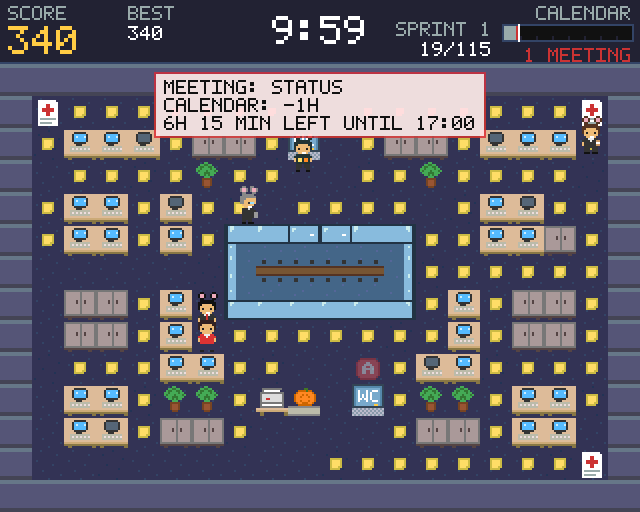
Timesheet pls gameplay: an open-plan office maze with chasers, as a pop-up says a status meeting just took an hour off the calendar

Timesheet pls

Playable

Maze chase through an open-plan office. Grab your tasks and dodge the four people who want you in a meeting. Every catch eats a slot of your 9-to-5.

Launch ↗
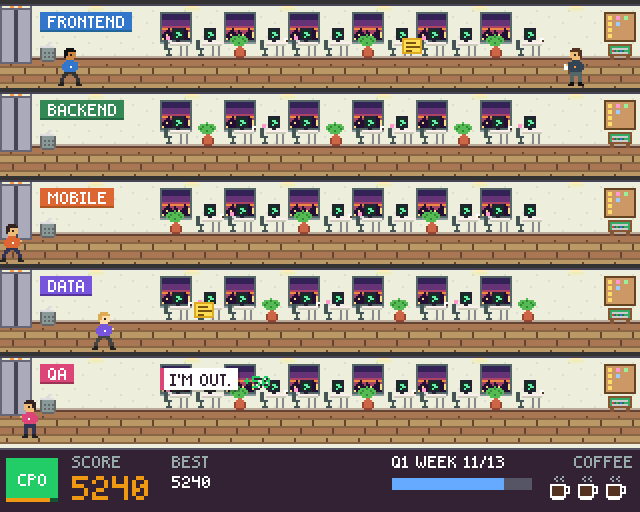
Tasker gameplay: five office floors named after dev teams, with developers and speech bubbles

Tasker

Playable

You are the Product Owner. Throw tickets down five team floors and catch the pull requests coming back, before the devs wander off to play foosball.

Launch ↗
Catch the Dev gameplay: an open-plan office with developers, speech bubbles and the daily meeting room

Catch the Dev

Playable

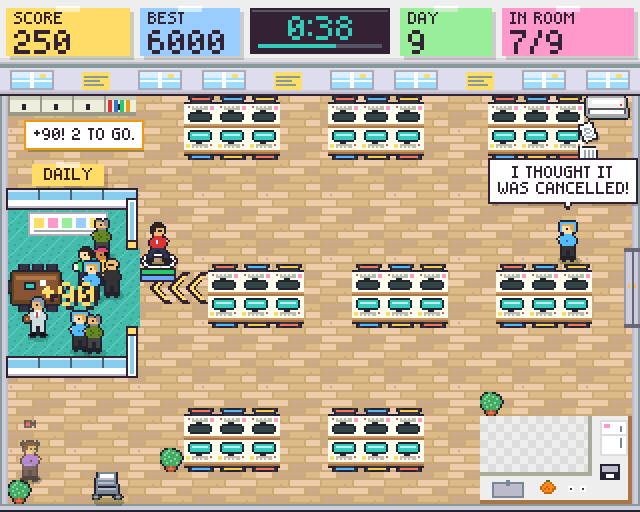
It is 9:00 and nobody is at stand-up. Round up developers into a conga line and march them to the daily. Longer chain, more points, slower you.

Launch ↗
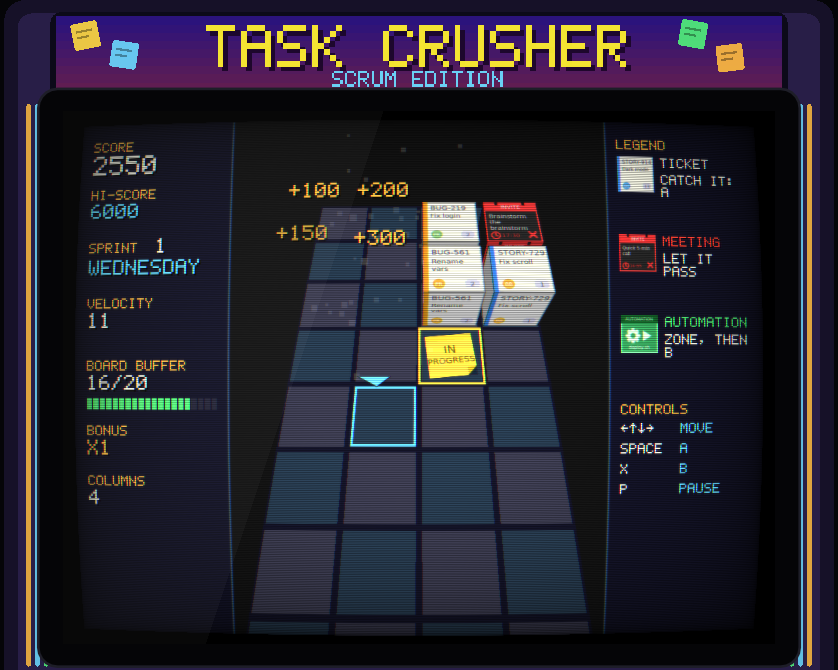
Task Crusher arcade cabinet mid-sprint: ticket cubes roll down a scrum board toward the deadline while caught tickets pop combo points

Task Crusher

Early build

Real-time puzzle inside an arcade cabinet. Crush the tickets rolling down the sprint board, let the meeting invites pass, deploy automations to clear in chains.

Launch ↗
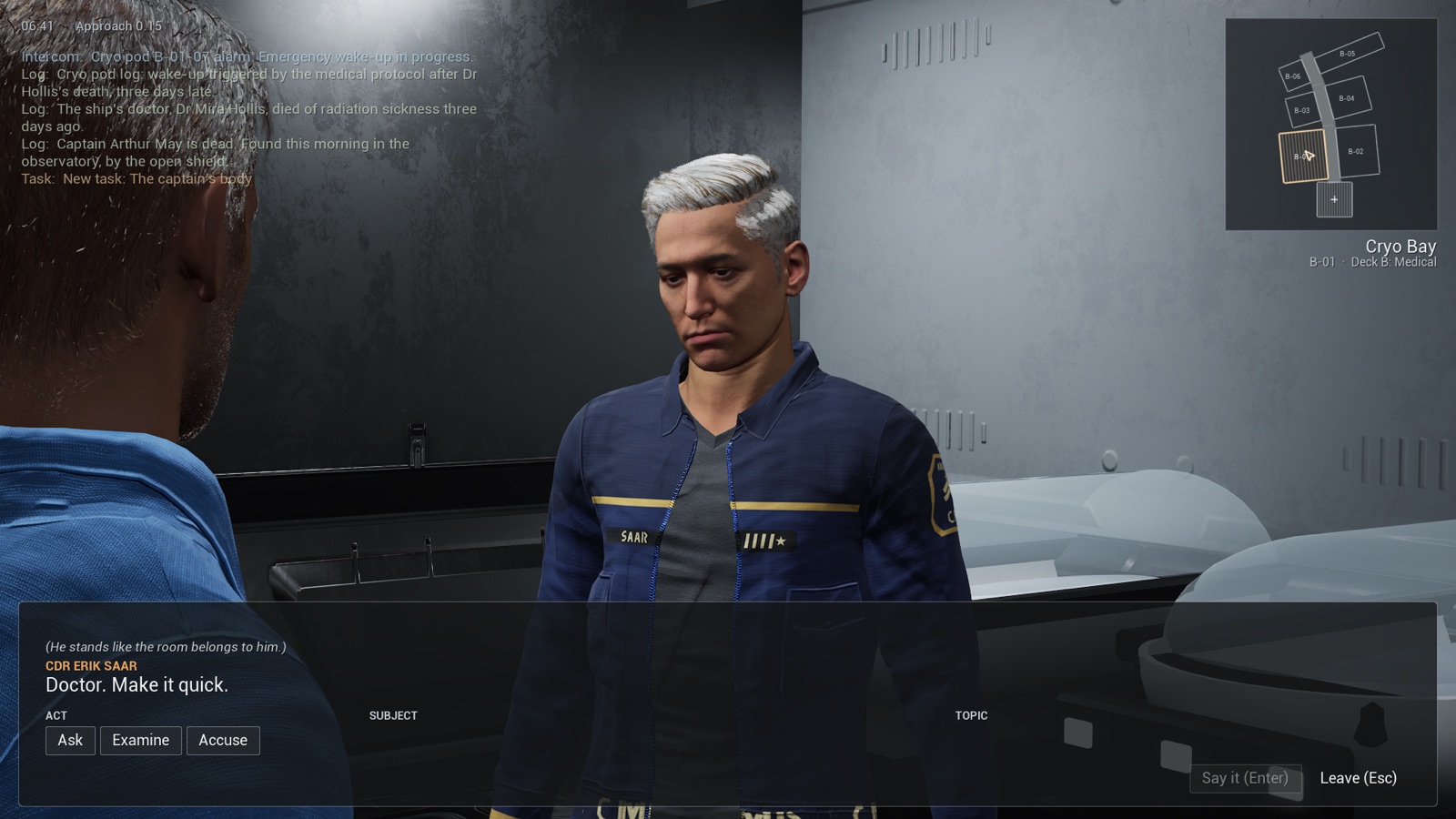
Peryhelium: a conversation with Commander Saar in the cryo bay, with Ask, Examine and Accuse options

The big one // coming soon

Peryhelium

A research station is falling into its star, the crew is sick and the captain is dead. You are the reserve medic, thawed out three days late.

No combat. You talk to people, and people lie. The killer, the motive and the lies are rolled from a seed, so no two runs match.

Unreal Engine 5 · C++ · act I playable

04 // About

A place for side projects. Experiments get written up, tools get used, games get shipped.